
The annual inspection on a composite ultralight: what actually gets checked
The annual condition inspection on a composite ultralight such as the Fly Synthesis Texan or Storch is the single most important event in the aircraft’s calendar. Over two or three days the inspector works through control surfaces, landing gear, brakes, fuel system and engine, measuring wear against the maintenance manual and grounding the aircraft until every item is signed off. On the Texan the carbon-fiber main gear legs get particular attention at their fuselage attachment points, while the Storch’s undercarriage is checked for cracks at the welded clusters.
Most owners underestimate how much preparation reduces both downtime and the final invoice. A clean aircraft lets the inspector see defects instead of dirt, and a tidy hangar with good lighting saves hours of searching. Typical findings on a well-kept Texan or Storch are minor: a slightly elongated rod end after a few hundred hours, hairline gel-coat cracks around the canopy latch, or a marginal drop in brake-fluid level. The inspection also triggers a weight-and-balance review against the 472.5 kg microlight limit or the 600 kg LSA class, depending on how the aircraft is registered.
Control Surfaces and Hinges
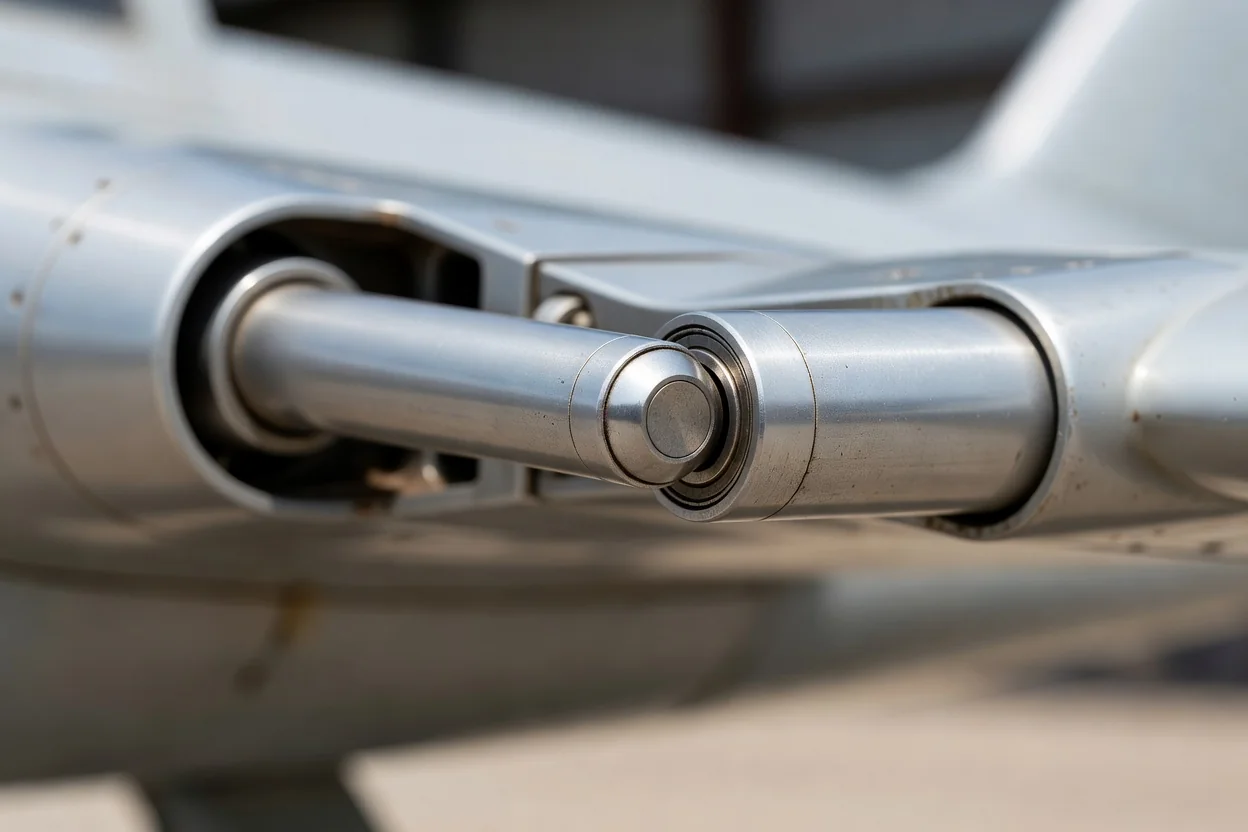
Begin the annual condition inspection by removing the aileron, flap and flaperon panels on the Fly Synthesis Texan or Storch. Measure free play at each hinge with a dial indicator; the manufacturer allows no more than 0.5 mm vertical and 1.0 mm lateral at the trailing edge. Worn stainless hinges are replaced because composite control surfaces magnify any slop into pilot-perceived vagueness at 1.3 times stall speed during approach. Typical findings after 300 hours include slight elongation of the hinge bolts on the outboard flaperon; these are torqued to 12 Nm and rechecked after 25 hours.
Push-pull rods and rod ends receive a full travel check. Any binding or corrosion on the 6 mm stainless rods that actuate the Texan’s all-moving tailplane demands immediate replacement. Lubrication with Boelube and proper torquing prevents the common mistake of over-tightening, which cracks the composite control horns.
Landing Gear and Brakes
The carbon-fiber landing-gear legs on the Texan are inspected for delamination at the four fuselage attachment bolts. Torque is verified at 22 Nm while the Storch’s steel legs are dye-penetrant checked at the welded joints. Brake discs must measure at least 4.5 mm thick; anything thinner is replaced during the annual condition inspection to preserve the hydraulic system’s integrity. Hydraulic lines are flexed by hand; a single crack visible under 10x magnification grounds the aircraft until new Aeroquip lines are fitted.
Fuel System Integrity
Drain the 50-liter wing tanks on both the Texan and Storch, then remove and clean the gascolator. Inspect the fuel lines from tank outlets to the Rotax 912 carburettors for chafing against the composite fuselage sides. Water or algae in the sample is a common finding after winter storage; it is eliminated with fresh 100LL or mogas and a fresh filter. The entire system is pressure-checked to 0.2 bar to confirm no leaks before the aircraft is signed off for another 100 hours.
Canopy, Electrical and Avionics
Canopy cracks usually start at the latch pins on the Storch after 500 hours of UV exposure. The annual condition inspection measures latch wear and replaces the pins if play exceeds 0.8 mm. The battery on a Rotax 912-powered ultralight is load-tested; any cell below 12.4 V after charging is replaced. If an ELT or Mode C transponder is fitted, its battery is replaced on calendar life and the unit is tested to FAR 91.411 standards even though the aircraft operates under microlight rules in Europe.
Risks, Limits and Common Owner Mistakes
Composite structures hide delamination until it is too late; therefore the inspector taps every accessible skin with a coin and listens for a dull thud. Ignoring this step is the most frequent mistake and can let delamination grow unseen on a high-time ultralight. Another common error is failing to update the weight-and-balance record after adding a new radio or wheel fairing; even 5 kg can push the Texan outside the 472.5 kg microlight limit and invalidate insurance.
Pilots who skip the control-surface free-play check often discover excessive play only after a heavy landing, when the hinge brackets have already cracked the spar carry-through. Always budget two full days on the ground; rushing the annual condition inspection almost guarantees missed items that surface later at 1.3 times stall speed on final approach.
- The inspector records every measurement against the Fly Synthesis maintenance manual limits before signing the logbook.
- Owners who pre-clean the aircraft and supply a digital copy of the last two inspections cut labor time by roughly 30 percent.
- Replacement rod ends and brake pads are inexpensive if ordered in advance from the Italian distributor.
- Any discrepancy exceeding published tolerances must be corrected before the aircraft may be flown again.
- Weight-and-balance calculations are redone with the aircraft empty and with full fuel to confirm CG remains inside limits.
- A fresh set of Rotax 912 spark plugs and oil filter is often installed during the same visit to keep the 2000-hour TBO on track.
| Item | Typical Limit | Common Finding | Action |
|---|---|---|---|
| Aileron hinge play | 0.5 mm | 0.7 mm | Replace bushings |
| Brake disc thickness | 4.5 mm | 4.2 mm | New discs |
| Fuel line pressure | 0.2 bar | 0.18 bar | Tighten clamps |
| Canopy latch wear | 0.8 mm | 1.1 mm | New pins |
| Gear bolt torque | 22 Nm | 19 Nm | Retorque |
| Battery voltage | 12.6 V | 12.1 V | Replace battery |
Preparing the aircraft, understanding what the inspector is looking for, and addressing small items early keeps the annual condition inspection on a Texan or Storch both affordable and thorough. The result is an ultralight you can trust at 1.3 times stall speed, through every flare and every crosswind landing for the next twelve months.